1. Defining the Software Extraction Objective
To Extract MCU PIC18F2423 Software is to investigate the executable information stored inside a PIC18F2423 microcontroller and determine how that information can be preserved, interpreted, or reused in an authorized engineering environment. The term software extraction can describe several different tasks: obtaining a binary image from accessible memory, examining an existing firmware archive, disassembling machine instructions, or reconstructing parts of the original program logic.
The PIC18F2423 belongs to Microchip’s PIC18 family of 8-bit microcontrollers. Unlike a general-purpose microprocessor that commonly relies on external memory and a broader computing platform, this MCU integrates program memory, data memory, control logic, and peripheral interfaces into a single IC. Its firmware therefore reflects both the application software and the hardware resources available on the chip.
Before attempting extraction, engineers should establish whether the objective is to recover an existing firmware image, understand the embedded software, or reproduce the original system’s behavior. These objectives require different methods and produce different results.
2. Mapping the Internal Memory Structure
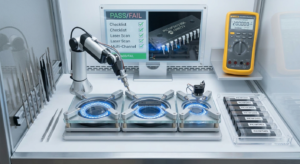
A useful starting point is to identify the PIC18F2423 memory organization and the relevant device configuration. Program Flash stores executable instructions, while SRAM holds temporary variables, buffers, and runtime state. EEPROM provides nonvolatile storage for application data that may need to survive a power cycle.
These memory regions serve different purposes and should not be treated as a single software container. A Flash dump, for example, may contain executable code and constant tables without revealing the complete application state. EEPROM data may include calibration values, operating parameters, counters, or device-specific settings. SRAM generally represents volatile runtime information and is not equivalent to an archived firmware image.
A reliable extraction record should identify the memory region, acquisition method, address range, file format, and any known gaps. Engineers should verify the exact device variant and consult its official Microchip datasheet before selecting programming commands or interpreting memory addresses.
3. Evaluating Binary Integrity Before Disassembly
A firmware file should be validated before its contents are interpreted. Common inputs include a raw BIN file, an Intel HEX file, or a backup preserved in a software archive. These formats are not interchangeable: a BIN file typically contains raw bytes, whereas an Intel HEX file includes address information and record checksums.
During analysis, the file length, address ranges, checksum results, and repeated data patterns can help identify truncation, unexpected padding, or an incomplete dump. If multiple firmware versions are available, a binary comparison can reveal modified instruction regions, changed lookup tables, and differences in configuration data.
The next stage is disassembly. PIC18 machine instructions must be decoded according to the architecture’s instruction set and memory addressing rules. Analysts can then examine branches, subroutine calls, interrupt handlers, peripheral registers, and data-processing routines. This process can expose program structure, but disassembled output is not the same as the original source code.
4. Understanding Locked and Protective Configurations
A PIC18F2423 may use configuration settings that restrict external access to program memory. These protective mechanisms can prevent a programmer from reading or verifying stored firmware through supported interfaces. A locked device does not necessarily contain encrypted software; readout protection and cryptographic encryption are different security mechanisms.
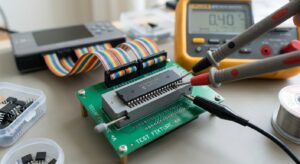
The term unlock must therefore be used carefully. It may refer to changing an access state through a documented procedure, but it does not imply that protected firmware can be recovered intact. Depending on the device configuration and operation selected, a bulk erase may destroy the program Flash that an engineer intends to preserve.
For this reason, configuration bits and the documented effects of programming commands should be reviewed before any destructive operation. If the original firmware is inaccessible, an existing authorized backup or a previously archived HEX image may be the only practical source for further analysis.
5. From Dumped Instructions to Functional Replication
When a valid memory image is available, the next challenge is determining what the embedded software actually does. Analysts can trace control flow, identify constants, map references to peripheral registers, and compare observed behavior against the circuit’s inputs and outputs.
The verbs dump and replicate describe distinct stages. Dumping refers to acquiring a memory image where access is permitted; replicating refers to reproducing the firmware or its externally observable behavior. A complete binary copy may support replication on compatible hardware, but it does not automatically explain the program’s design or guarantee that the software will operate correctly in another system.
Reconstructing source code from machine instructions is also inherently limited. Function boundaries and algorithmic patterns may be identifiable, but original variable names, comments, project settings, and high-level design decisions are generally absent unless separately preserved.
6. Preserving the Results
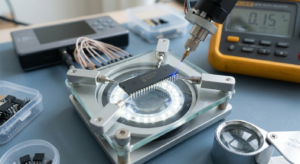
A sound PIC18F2423 software investigation should preserve the original file, document the acquisition conditions, record cryptographic hashes, and keep extracted data separate from modified working copies. Any recovered firmware should be associated with its device variant, configuration information, and known limitations.
Ultimately, Extract MCU PIC18F2423 Software is best understood as a structured process involving memory assessment, binary verification, instruction-level analysis, and careful preservation. Whether the target is accessible, locked, or supported only by an old archive, the quality of the result depends on accurate device identification and a clear distinction between recovered firmware, reconstructed source code, and verified functional behavior.