In many embedded products, the software inside a controller is just as important as the PCB and electronic components surrounding it. The PIC18F2410 is an 8-bit microcontroller from microchip designed for embedded control applications where program execution, digital I/O, timers, analog functions, communication, and non-volatile storage need to work together. Its flash-based program memory and EEPROM make it suitable for retaining both application instructions and selected persistent data.
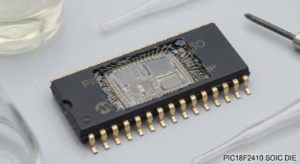
Depending on the product design, a PIC18F2410 may be used in industrial automation equipment, instrumentation, automotive-related controllers, monitoring devices, power-control systems, and specialized consumer electronics. For manufacturers maintaining an established product, the original chip can therefore contain information that is difficult to reproduce after the engineering archive or source code has been lost.
When using the DAC in S/H mode, ensure that none of the channels is running at maximum conversion rate, or ensure that the conversion rate of both channels is high enough to not require refresh.
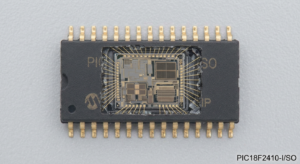
The phrase copy microcontroller PIC18F2410 heximal generally refers to recovering a usable representation of the information stored inside a target MCU, particularly when the original firmware is unavailable. The situation becomes more challenging when the microprocessor has been configured as secured, protected, or locked, preventing ordinary programming tools from reading its internal memory. Depending on the project requirements, engineers may investigate whether the flash program area or eeprom can be extracted and preserved as a binary or heximal file.
A resulting dump can become part of an engineering archive, allowing the recovered program and associated data to be examined later. Although terms such as hack or open are sometimes used when describing access to a protected device, professional recovery is better viewed as a controlled engineering investigation. reverse engineering may then be required to determine how recovered firmware relates to the original hardware. Importantly, a binary or heximal image is not automatically equivalent to the original source code; it represents compiled information that may require further technical interpretation.
Problem fix/Workaround
Do not set the BOD level higher than VCC even if the BOD is not used.
Both DFLLs and both oscillators has to be enabled for one to work
In order to use the automatic runtime calibration for the 2 MHz or the 32MHz internal oscillators, the DFLL for both oscillators and both oscillators has to be enabled for one to work.
Problem fix/Workaround
Operating Frequancy and Voltage Limitation
To ensure correct operation, there is a limit on operating frequnecy and voltage. Figure 36-2 on page 95 shows the safe operating area.
Bandgap voltage input for the ACs cannot be changed when used for both ACs simultaneously
ADC gain stage output range is limited to 2.4V
Sampled BOD in Active mode will cause noise when bandgap is used as reference
Bandgap measurement with the ADC is non-functional when VCC is below 2.7V
BOD will be enabled after any reset
Writing EEPROM or Flash while reading any of them will not work after the ADC has increased INL error for some operating conditions DAC has increased INL or noise for some operating conditions VCC voltage scaler for AC is non-linear Maximum operating frequency below 1.76V is 8 MHz.
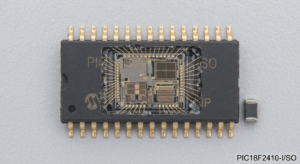
Protection is only one part of the problem. A decades-old board may contain a locked PIC18F2410 alongside components that have suffered electrical stress, corrosion, mechanical damage, or previous repair attempts. Even when memory contents can be recovered, engineers must determine whether the resulting file is complete and internally consistent. An encrypted representation, where applicable, can introduce another layer of uncertainty, while corrupted memory may produce a seemingly valid dump containing incomplete information.
The objective of restore work is therefore not simply to produce as many bytes as possible. Engineers examine the available firmware, flash, eeprom, program, and application data as parts of a larger embedded system, using reverse engineering to establish their relationship where appropriate. The exact approach to dealing with individual protection mechanisms is project-specific, so the service can remain focused on results without exposing sensitive technical procedures for defeating a particular security configuration.
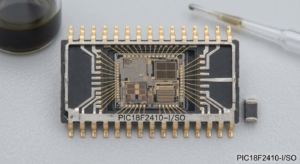
Recovering the contents of a PIC18F2410 can be especially valuable when a client needs to reproduce an existing product without recreating its embedded software completely from the beginning. A preserved binary or heximal image may support replacement-board development, production continuity, troubleshooting, functional comparison, or migration toward a newer microcontroller. It can also provide an important reference when the original software archive has disappeared and no usable source code remains.
For discontinued equipment, recovering information from an existing chip may help retain proven control behavior while reducing the engineering effort required for a new design. The broader significance of copy microcontroller PIC18F2410 heximal is therefore the preservation of embedded knowledge: rather than allowing an obsolete controller to become an irreversible barrier to maintenance, its recoverable information can contribute to documentation, redesign, repair, and long-term product support.