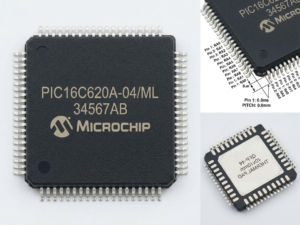
The PIC16C620A belongs to an earlier generation of compact embedded controllers that helped establish the foundation for many dependable electronic products. Although newer processors now provide considerably greater memory capacity and processing resources, this type of microcontroller can still be found inside long-service equipment where reliability and predictable operation are more important than computing power. Its architecture was designed for straightforward control applications, with programmable memory, data storage capabilities, timers, input/output resources, and other functions suitable for dedicated electronic control. Products using this MCU may include industrial control panels, measurement instruments, household appliances, alarm equipment, simple communication devices, and specialized machinery. When such products remain in service for many years, the original firmware can become more valuable than the hardware itself. Missing development documents, unavailable engineers, discontinued suppliers, or damaged computer archives can make it difficult to reproduce the original program, creating a practical reason to investigate how to read microcontroller PIC16C620A firmware from an existing chip.
The LTS/HTS bits will reflect the current active status of the LFINTOSC and the HFINTOSC oscillators. The timing of a frequency selection is as follows:
IRCF bits are modified.
If the new clock is shut down, a 10 ìs clock start-up delay is started.
Clock switch circuitry waits for a falling edge of the current clock.
If the internal oscillator speed selected is between 8 MHz and 125 kHz, there is no start-up delay before the new frequency is selected. This is because the old and the new frequencies are derived from the HFINTOSC via the postscaler and multiplexer.
The system clock source can be switched between external and internal clock sources via software using the System Clock Select (SCS) bit. The System Clock Select (SCS) bit (OSCCON<0>) selects the system clock source that is used for the CPU and peripherals.
- When SCS = 0, the system clock source is determined by configuration of the FOSC<2:0> bits in the Configuration Word register (CONFIG).
When SCS = 1, the system clock source is chosen by the internal oscillator frequency selected by the IRCF bits. After a Reset, SCS is always cleared.
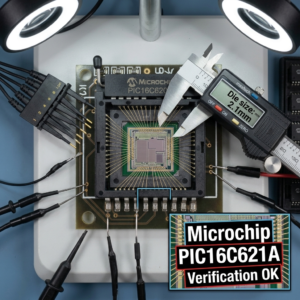
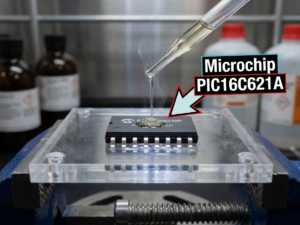
Recovering information from an old protected device is fundamentally different from reading an ordinary memory file. When engineers need to extract, recover, open, or restore firmware from a secured microcontroller, the principal objective is to understand what information remains accessible without unnecessarily exposing sensitive technical procedures. A locked chip can prevent conventional programming equipment from producing a useful binary dump, while protected memory can return incomplete, invalid, or apparently empty data.
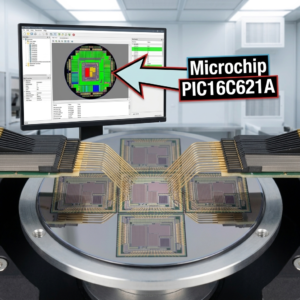
Depending on the condition of the device, reverse engineering specialists may examine the relationship between firmware, program memory, eeprom, flash, memory configuration, and stored data before determining an appropriate recovery strategy. The required archive may contain a binary file, heximal representation, configuration information, calibration values, or other program data rather than readable source code. Additional complications can arise from aging components, electrical damage, previous programming attempts, corrupted files, or security mechanisms intended to prevent unauthorized access. Consequently, attempts to hack or extract information from a secured chip require careful laboratory analysis rather than simply connecting the microprocessor to a conventional programmer. The emphasis is on preserving the original device and determining whether a reliable firmware recovery is technically possible.
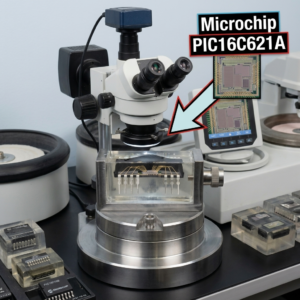
There is also an important distinction between recovering legacy firmware and attempting to obtain information for unauthorized duplication. In legitimate engineering projects, the purpose may be to maintain equipment that has been operating for decades, diagnose a failed controller, rebuild a discontinued replacement board, or transfer an existing program to a compatible production environment. A manufacturer may possess the physical product but have lost the original software archive after a company restructuring or storage failure. A maintenance provider may have dozens of identical machines in the field but no longer have access to the original program file. In these circumstances, recovering the information stored inside a protected MCU can preserve continuity without requiring an entirely new software development project. Reverse engineering can also help identify whether a recovered dump corresponds to the expected firmware version and whether the available data is complete enough for restoration. Because every chip has its own physical condition and protection state, there is no universal recovery result, and some secured devices may remain impossible to read successfully.
Note
Any automatic clock switch, which may occur from Two-Speed Start-up or Fail-Safe Clock Monitor, does not update the SCS bit. The user can monitor the OSTS (OSCCON<3>) to determine the current system clock source. The Oscillator Start-up Time-out Status (OSTS) bit (OSCCON<3>) indicates whether the system clock is running from the external clock source, as defined by the FOSC bits, or from the internal clock source by Read Microcontroller PIC16C620A Firmware. In particular, OSTS indicates that the Oscillator Start-up Timer (OST) has timed out for LP, XT or HS modes.
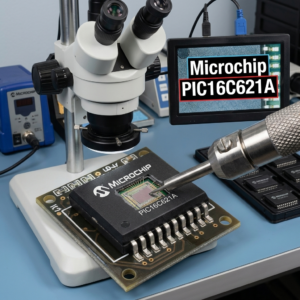
For clients, the practical value of firmware recovery lies in preserving existing engineering assets and reducing the disruption associated with obsolete electronics. A usable firmware archive can assist with equipment repair, replacement-controller production, compatibility testing, technical documentation, and long-term maintenance. It may also provide a reference when a company needs to recreate an unavailable program environment or understand the behavior of an old electronic product. Rather than treating an aging microcontroller as an isolated component, specialists can regard its remaining firmware and memory contents as part of a larger engineering archive containing years of product knowledge. This approach can help organizations extend the useful life of legacy equipment, avoid unnecessary redesign, and maintain products whose original development resources have disappeared. For businesses working with older embedded platforms, the ability to assess, recover, and restore firmware from a protected PIC16C620A can therefore represent an important part of responsible technology preservation and lifecycle management.