
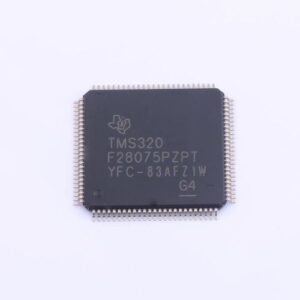
A binary file is a claim about byte order, word width and what counts as address zero. On a TMS320F28075 that claim has to be made carefully, because the array is 256K words of 16 bits with ECC alongside, the OTP is a separate region with its own rules, and the security configuration decides which parts of the map a reader is even allowed to see.
Words, Bytes And The ECC Question
The C28x addresses memory in 16-bit words. A binary for a programmer is a byte stream. Converting between them is trivial until ECC enters the picture: the array stores check bits for each word, those bits occupy real locations, and whether they belong in the output depends on what the file will be used for.
For reflashing, they do not — the programmer recalculates them. For analysis, they do, because a word whose ECC does not match its data is a word that was disturbed, and that is the fastest way to find a bad read. We therefore produce two files: a clean image for programming and an annotated image with ECC for verification, and we say which is which in the filename.
Where The Map Starts
Address zero in the file is not address zero in the device. The array begins at a fixed offset in the memory map, the boot ROM occupies its own range, and the OTP sits elsewhere again. A binary that starts at the array’s first word and a HEX that starts at the array’s first address describe the same content with different conventions.
We state the base address explicitly in the report and in the HEX’s extended address records, because a customer importing a binary at the wrong base gets a part that runs the first instruction of the program from an address the linker never intended.
What The OTP Explains
On this device the security configuration lives in OTP, and a binary read of the array alone cannot explain a protected region. The OTP dump provides the zone boundaries, the execute-only marks, and the JTAG lock state. Without it, a gap in the image is ambiguous; with it, the gap has a name.
That is why the OTP is read first and delivered as a separate small file rather than folded into the image. It is configuration, not program, and it does not belong in a programming file that will be written to a different part.
Reading Order And Integrity
The array is read in overlapping windows, each validated by checksum before the next begins. A window that fails is re-read rather than patched, and the overlap log ships with the delivery so the stitching can be audited.
The upper region of the array on this device is often dense constant data — filter coefficients for the sigma-delta modules, tables for the configurable logic block, gain schedules. Those regions read as regular patterns and are the hardest to confirm by inspection, which is why the checksum chain matters more here than on a code-heavy image.
The File That Survives A Review
A binary delivered without context is a liability. Six months later nobody remembers which base address it assumed, whether ECC is included, or which zone was read. The report therefore carries the parameters as data rather than as prose: base address, word width, byte order, ECC state, zone coverage, and the checksum of each region, in a table that can be pasted into a build system.
That is not bureaucracy. A production engineer who receives three files from three suppliers needs to know which one is authoritative, and the answer has to be in the files themselves.
Peripherals That Leave Fingerprints In The File
Sixteen high-resolution PWM channels, eight sigma-delta filter inputs and a configurable logic block all have initialisation data in flash. The logic block in particular stores a truth-table image that looks like arbitrary data and is in fact a small program. Recognising it prevents it being discarded as padding.
Delivery
The programming binary, the annotated image with ECC, the OTP dump, the window overlap log, the zone map, the parameter block, and per-region checksums. Where a region was execute-only, the report says it was read physically.
The security architecture of this device is described in more depth on the TMS320F28075 readout page, and the previous generation with in-array passwords is covered by the TMS320F28067 job. Binary-format questions go through the services desk or the contact form.