
The TMS320F28054 and the TMS320F28055 are the same silicon. One has its control law accelerator enabled at test, the other does not, and the difference is a configuration bit rather than a mask change. That matters to anyone reading a locked unit, because the array of a 28054 can contain CLA task code that the part never executes — leftovers from a build that targeted the other variant.
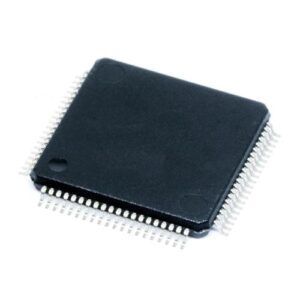
One Die, Two Part Numbers
Sixty-four thousand words of flash, ten thousand words of SARAM, sixty megahertz, fourteen ePWM channels, sixteen ADC inputs, seven comparators and four PGAs: the memory and analogue set is identical across the pair. What differs is whether the accelerator block is active. Programming a 28054 with an image built for a 28055 produces a part that boots, runs the main loop, and silently never executes the tasks the accelerator was supposed to handle.
For a readout this cuts both ways. It means an image recovered from a 28054 may contain code the original part never ran, which has to be flagged rather than presented as active firmware. It also means a customer can migrate a 28054 design to the accelerator variant by reflashing, provided the recovered image includes the task code.
Recognising The Leftovers
CLA code in a 28054 image is identifiable but not always present. The task table is initialised only when the accelerator is enabled, so on a genuine 28054 build the eight task vectors either point at a shared null routine or are never written at all. A table full of distinct addresses is evidence of a build that expected the accelerator to run.
We check that before reconstruction and mention it in the report, because it changes how the image should be judged: a task table pointing at plausible routines but never triggered is not a defect, it is a configuration artefact.
Dual-Zone On A Part With Room To Split
With 128 KB there is space for a meaningful two-zone split, and designs that use this part often do exactly that: application in Zone 1, a licensed library in Zone 2, each with its own password. The zones are configured in OTP at programming time, so the boundary is discoverable before any password is known.
If the customer holds one password and not the other, the job becomes a single-zone read plus a physical read of the remainder, and the two results are merged by address. That merge has to be exact; an off-by-one at the boundary produces a call that lands one word into the wrong routine.
The Analogue Calibration Question
Four PGAs and seven comparators mean the firmware carries gain and trip values that were tuned on a specific board. On this device those values sit in flash, not in factory OTP, which makes them part of the firmware image rather than part of the silicon. Recovering them is automatic; validating them is not, because a comparator threshold is only meaningful against the shunt it was designed for.
We deliver them as a named block with the register writes that consume them, so a rebuild team can check each value against its own schematic instead of accepting a number from a dump.
Reading The Variant From The Marking
Part numbers on this family differ by a single character, and that character decides whether an accelerator block is active. Marking photographs settle it before anything else happens, and the die confirms it: the two variants share a mask, so the only difference visible under a microscope is which configuration words were programmed at test.
That is worth stating plainly to customers who send a mixed batch. A 28054 image that contains accelerator task code is not a corrupt 28054 — it is a build that was written for the sibling and flashed into a part that cannot run it. The report distinguishes the two cases.
What Verification Looks Like Here
Three checks, in order of how much they catch. PWM dead-band and start-up sequence first, because they exercise the initialisation code. ADC trigger phase second, because it exercises the PWM-to-ADC mapping. Comparator trip point third, because it exercises the analogue configuration and is the only one that can fail while the other two pass.
Handover
The HEX, the binary, the zone map, the calibration block, whichever passwords were recovered, and a note on whether the image contains inactive accelerator code. Per-region checksums travel with all of it.
The accelerator-enabled twin is described on the TMS320F28055 page, and the 64 KB dual-zone part with the accelerator is the TMS320F28053 job. Send a marking photo with the quantity through the services desk or the contact form and the variant is confirmed before the quote.