
The continuity of complex industrial electronics often relies on the longevity of specialized microcomponents buried deep within control circuit assemblies. When an engineering team encounters an unpreventable system failure or loses vital documentation, the technical capability to perform a secured microcontroller pic18f2515 code extraction surfaces as an indispensable tool for business asset protection. The pic18f2515 is a high-performance 8-bit device that features a generous 48 kilobytes of high-density linear program storage, an integrated enhanced capture/compare/pwm module, and advanced SPI/I2C communication channels.
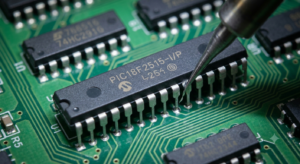
Because it effectively balances advanced peripheral integration with rugged physical durability, original design manufacturers extensively deployed this specific microcontroller within automotive diagnostic transceivers, commercial building automation controllers, maritime telemetry units, and localized medical fluid regulators. When these aging architectures encounter a sudden breakdown, accessing the internal silicone structure becomes the only logical path to prevent massive logistical downtime and protect large-scale capital investments from total platform obsolescence.
Enabling any on-chip feature that will operate during Sleep will increase the current consumed during Sleep. The INTRC is required to support WDT operation. The Timer1 oscillator may be operating to support a real-time clock. Other features may be operating that do not require a device clock source (i.e., SSP slave, PSP, INTn pins and others). Peripherals that may add significant current consumption are listed in Section 26.2 “DC Characteristics”. Power-up delays are controlled by two timers, so that no external Reset circuitry is required for most applications. The delays ensure that the device is kept in Reset until the device power supply is stable under normal circumstances and the primary clock is operating and stable. For additional information on power-up delays, see Section 4.5 “Device Reset Timers”.
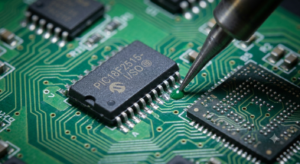
The first timer is the Power-up Timer (PWRT), which provides a fixed delay on power-up (parameter 33, Table 26-10). It is enabled by clearing (= 0) the PWRTEN configuration bit. The second timer is the Oscillator Start-up Timer (OST), intended to keep the chip in Reset until the crystal oscillator is stable (LP, XT and HS modes). The OST does this by counting 1024 oscillator cycles before allowing the oscillator to clock the device. When the HSPLL Oscillator mode is selected, the device is kept in Reset for an additional 2 ms, following the HS mode OST delay, so the PLL can lock to the incoming clock frequency. There is a delay of interval TCSD (parameter 38, Table 26-10), following POR, while the controller becomes ready to execute instructions. This delay runs concurrently with any other delays. This may be the only delay that occurs when any of the EC, RC or INTIO modes are used as the primary clock source.
PIC18F2515 devices offer a total of seven operating modes for more efficient power management. These modes provide a variety of options for selective power conservation in applications where resources may be limited (i.e., battery-powered devices). There are three categories of power managed modes:
- Run modes
- Idle modes
- Sleep mode
These categories define which portions of the device are clocked and sometimes, what speed. The Run and Idle modes may use any of the three available clock sources (primary, secondary or internal oscillator block); the Sleep mode does not use a clock source. The power managed modes include several power-saving features offered on previous PICmicro® devices. One is the clock switching feature, offered in other PIC18 devices, allowing the controller to use the Timer1 oscillator in place of the primary oscillator. Also included is the Sleep mode, offered by all PICmicro devices, where all device clocks are stopped.
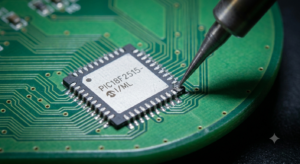
To successfully extract the functional logic from a secured or locked semiconductor, laboratory technicians must navigate a highly complex array of silicon-level defenses. The principal obstacle encountered when trying to hack or open an encrypted component involves manipulating the internal configuration fuses that natively block standard programming interfaces. The microcontroller utilizes active monitoring lines designed to track internal clock frequencies and power-rail fluctuations; if an invalid reading sequence or a probing anomaly is detected, the microprocessor will instantly trigger a global self-erase sequence to destroy the volatile flash program memory and adjacent eeprom cells. Carefully bypassing these active layers requires highly precise signal manipulation methods designed to safely read out the internal layout without clearing the storage registers. Once these security blocks are neutralized, engineers can safely pull a complete memory dump, capturing the raw binary or heximal file needed to restore and replicate the system’s operational parameters.
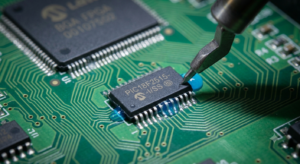
Recovering this vital information is a critical defensive maneuver driven by practical engineering necessity rather than academic curiosity. When original equipment manufacturers stop supporting older hardware generations, declare bankruptcy, or refuse to share legacy control files, companies often face a forced, multi-million dollar infrastructure overhaul. Having an uninhibited window into the system’s operational logic provides a definitive shield against vendor lock-in and supply chain vulnerabilities. It gives engineering departments the freedom to repair failing electronics, optimize legacy equipment for modern efficiency standards, and ensure strict long-term compliance. This precise technical capability effectively converts an impenetrable, depreciating hardware liability back into a fully visible, documented corporate asset, ensuring that the critical machine behavior is preserved without needing the manufacturer’s original source code.
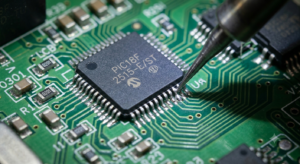
Ultimately, obtaining a flawless heximal or binary file from a protected integrated circuit yields profound commercial benefits for our clients. By moving through a rigorously managed hardware reverse engineering cycle, corporate asset managers can effectively insulate themselves against forced platform migration and predatory vendor lock-in. Having a clean, verifiable copy of the mcu code grants internal development teams the power to audit legacy algorithms, clone end-of-life components onto highly sustainable circuit paths, and implement crucial cyber-security patches without redesigning the architecture from zero. This proactive technical capability successfully changes an unreadable, locked hardware barrier back into a completely transparent, well-documented software asset—drastically lowering operational overhead, bypassing unpredictable global logistics constraints, and guaranteeing business continuity for years to come.