
Extracting data from secured microcontrollers has long been a critical challenge in the field of embedded system analysis and reverse engineering. Among them, the Read MCU AT89C51CC03 Flash operation stands as one of the more difficult tasks due to the chip’s protected architecture and embedded security mechanisms.
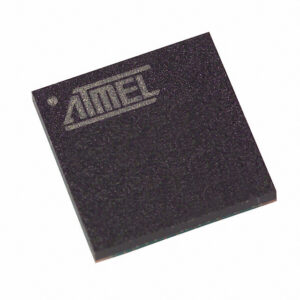
The AT89C51CC03, developed by Atmel (now part of Microchip), is a high-performance 8-bit microcontroller based on the industry-standard 8051 core. This MCU includes an integrated Flash memory, EEPROM, CAN controller, and advanced programmable I/O features, making it ideal for automotive and industrial applications. What sets this chip apart is not just its versatility, but its deeply encrypted, locked, and secured Flash and EEPROM regions, specifically designed to deter unauthorized access and reverse engineering.
The process to extract, dump, or read the Flash memory of this MCU involves bypassing several layers of hardware-based and software-based protections. The primary objective is to recover the original firmware, which may be stored in heximal or binary format, and often contains critical operational logic or proprietary source code. Engineers or analysts may attempt to clone, copy, or replicate the program for legitimate reasons like system backup, migration, or legacy system support.
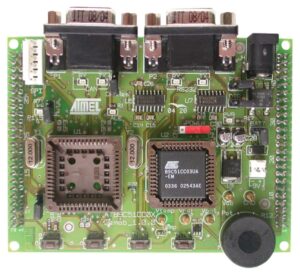
However, the challenges are significant. First, the AT89C51CC03 features a security fuse that disables standard programming interfaces once activated. Any standard attempt to read, copy, or restore its Flash will return a blank result. Second, the chip employs encryption of internal data and uses internal memory management to thwart dump or archive extraction. In many cases, this necessitates sophisticated attack methodologies such as decapsulation (removing the chip’s physical casing), probing internal buses, or using fault injection techniques to disrupt security circuits.
Successfully executing a break, crack, or decrypt operation on such a chip typically involves microprobing, scanning electron microscopy (SEM), or advanced laser fault injection—methods that require expensive lab equipment and deep expertise in microprocessor behavior.
Despite the complexity, if achieved, one can potentially restore or duplicate the entire operational file, enabling further analysis, reverse engineering, or even system reconstruction. While ethical boundaries and legal considerations must always be observed, the ability to Read MCU AT89C51CC03 Flash serves as a powerful demonstration of modern embedded security—and the lengths to which one must go to recover what lies within a protected and secured chip.
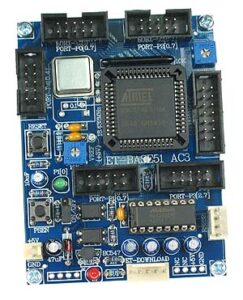
Read MCU AT89C51CC03 Flash content out from the microcontroller AT89C51CC03 after unlock microcontroller‘s protective mechanism which include the encrypted algorithm and cut off security fuse bit;
In a Master configuration, the SS line can be used in conjunction with the MODF flag in the SPI Status register (SPSCR) to prevent multiple masters from driving MOSI and SCK (see Error conditions). A high level on the SS pin puts the MISO line of a Slave SPI in a high-impedance state. The SS pin could be used as a general-purpose if the following conditions are met when extract microcontroller firmware.
The device is configured as a Master and the SSDIS control bit in SPCON is set. This kind of configuration can be found when only one Master is driving the network and there is no way that the SS pin could be pulled low. Therefore, the MODF flag in the SPSCR will never be set(1). The Device is configured as a Slave with CPHA and SSDIS control bits set(2). This kind of configuration can happen when the system includes one Master and one Slave only. Therefore, the device should always be selected and there is no reason that the Master uses the SS pin to select the communicating Slave device.
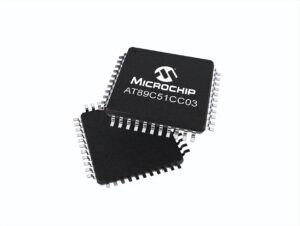
Note:
- Clearing SSDIS control bit does not clear MODF.
- Special care should be taken not to set SSDIS control bit when CPHA =’0’ because in this mode, the SS is used to start the transmission.
In Master mode, the baud rate can be selected from a baud rate generator which is controlled by three bits in the SPCON register: SPR2, SPR1 and SPR0.The Master clock is selected from one of seven clock rates resulting from the division of the internal clock by 4, 8, 16, 32, 64 or 128 after Read Microcontroller firmware.
Table 90 gives the different clock rates selected by SPR2:SPR1:SPR0. In Slave mode, the maximum baud rate allowed on the SCK input is limited to Fsys/4 The Serial Peripheral Interface can be configured in one of the two modes: Master mode or Slave mode. The configuration and initialization of the SPI Module is made through two registers:
The Serial Peripheral Control register (SPCON)
The Serial Peripheral Status and Control Register (SPSCR)
Once the SPI is configured, the data exchange is made using:
The Serial Peripheral DATa register (SPDAT)

During an SPI transmission, data is simultaneously transmitted (shifted out serially) and received (shifted in serially). A serial clock line (SCK) synchronizes shifting and sampling on the two serial data lines (MOSI and MISO). A Slave Select line (SS) allows individual selection of a Slave SPI device; Slave devices that are not selected do not interfere with SPI bus activities before remove chip extraction protection.
The SPI operates in Master mode when the Master bit, MSTR (1), in the SPCON register is set. Only one Master SPI device can initiate transmissions. Software begins the transmission from a Master SPI Module by writing to the Serial Peripheral Data Register (SPDAT). If the shift register is empty, the Byte is immediately transferred to the shift register.
The Byte begins shifting out on MOSI pin under the control of the serial clock, SCK. Simultaneously, another Byte shifts in from the Slave on the Master’s MISO pin. The transmission ends when the Serial Peripheral transfer data flag, SPIF, in SPSCR becomes set. At the same time that SPIF becomes set, the received Byte from the Slaves transferred to the receive data register in SPDAT. Software clears SPIF by reading the Serial Peripheral Status register (SPSCR) with the SPIF bit set, and then reading the SPDAT.
The SPI operates in Slave mode when the Master bit, MSTR (2), in the SPCON register is cleared. Before a data transmission occurs, the Slave Select pin, SS, of the Slave device must be set to’0’. SS must remain low until the transmission is complete. In a Slave SPI Module, data enters the shift register under the control of the SCK from the Master SPI Module.
After a Byte enters the shift register, it is immediately transferred to the receive data register in SPDAT, and the SPIF bit is set. To prevent an overflow condition, Slave software must then read the SPDAT before another Byte enters the shift register (3). A Slave SPI must complete the write to the SPDAT (shift register) at least one bus cycle before the Master SPI starts a transmission. If the write to the data register is late, the SPI transmits the data already in the shift register from the previous transmission.