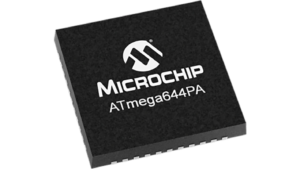
Extract MCU ATmega644PA Code is a specialized technical service focused on retrieving binary and heximal files from a secured ATmega644PA microcontroller when conventional readout methods are blocked. In many embedded designs, the firmware stored inside the flash memory defines the complete behavior of the product, from communication protocols to control logic. When the chip is protected, encrypted, or fuse-locked, direct access to its internal memory, EEPROM, and program space is intentionally restricted. Through disciplined reverse engineering methodologies, it becomes possible to extract, recover, and restore critical data archives from a locked MCU. The goal is to obtain a reliable binary dump or memory file without compromising the structural integrity of the microprocessor or altering the stored program.
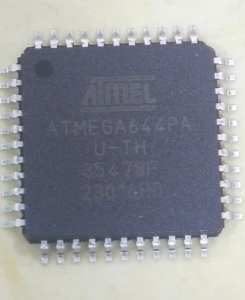
Extract MCU ATmega644PA Code is a process to recover MCU ATmega644PA flash memory content by cracking microcontroller ATmege644PA fuse bit;
When the BOD is enabled, and VCC decreases to a value below the trigger level (VBOT- in Figure 29), the Brown-out Reset is immediately activated. When VCC increases above the trigger level (VBOT+ in Figure 29), the delay counter starts the MCU after the Time- out period tTOUT has expired.
The BOD circuit will only detect a drop in VCC if the voltage stays below the trigger level for longer than tBOD given in Table 23. When the Watchdog times out, it will generate a short reset pulse of one CK cycle duration.
On the falling edge of this pulse, the delay timer starts counting the Time-out period tTOUT. See “Watchdog Timer” on page 56. for details on operation of the Watchdog Timer.
The ATmega644PA is a low-power AVR microcontroller engineered for stable performance in demanding embedded environments. It provides generous flash capacity for application firmware, EEPROM for parameter storage, and SRAM for runtime data handling. Integrated peripherals include SPI, USART, TWI (I²C), multiple timers with PWM capability, ADC channels, watchdog timers, and flexible GPIO resources. These features make the ATmega644PA chip highly suitable for industrial control boards, intelligent power management systems, medical monitoring devices, access control units, smart agriculture controllers, and advanced consumer appliances. In such deployments, the microcontroller acts as the central processing unit of the system, executing firmware instructions stored in its flash memory and managing real-time data exchange across connected modules.

ATmega644PA features an internal bandgap reference. This reference is used for Brown-out Detection, and it can be used as an input to the Analog Comparator or the ADC to .
The voltage reference has a start-up time that may influence the way it should be used. The start-up time is given in Table 26. To save power, the reference is not always turned The reference is on during the following situations:
- When the BOD is enabled (by programming the BODLEVEL [2..0] Fuse).
- When the bandgap reference is connected to the Analog Comparator (by setting the ACBG bit in ACSR).
- When the ADC is enabled.
Thus, when the BOD is not enabled, after setting the ACBG bit or enabling the ADC, the user must always allow the reference to start up before the output from the Analog Comparator or ADC is used. To reduce power consumption in Power-down mode, the user can avoid the three conditions above to ensure that the reference is turned off before entering Power-down mode. ATmega644PA has an Enhanced Watchdog Timer (WDT). The main features are:
- Clocked from separate On-chip Oscillator
- 3 Operating modes
– Interrupt
– System Reset
– Interrupt and System Reset
- Selectable Time-out period from 16ms to 8s
- Possible Hardware fuse Watchdog always on (WDTON) for fail-safe modeThe Watchdog Timer (WDT) is a timer counting cycles of a separate on-chip 128 kHz oscillator. The WDT gives an interrupt or a system reset when the counter reaches a given time-out value. In normal operation mode, it is required that the system uses the WDR – Watchdog Timer Reset – instruction to restart the counter before the time-out value is reached. If the system doesn’t restart the counter, an interrupt or system reset will be issued.
In Interrupt mode, the WDT gives an interrupt when the timer expires. This interrupt can be used to wake the device from sleep-modes, and also as a general system timer. One example is to limit the maximum time allowed for certain operations, giving an interrupt when the operation has run longer than expected.
-
- Within the next four clock cycles, write the WDE and Watchdog prescaler bitsIn System Reset mode, the WDT gives a reset when the timer expires. This is typically used to prevent system hang-up in case of runaway code. The third mode, Interrupt and System Reset mode, combines the other two modes by first giving an interrupt and then switch to System Reset mode. This mode will for instance allow a safe shutdown by saving critical parameters before a system reset.
The Watchdog always on (WDTON) fuse, if programmed, will force the Watchdog Timer to System Reset mode. With the fuse programmed the System Reset mode bit (WDE) and Interrupt mode bit (WDIE) are locked to 1 and 0 respectively. To further ensure program security, alterations to the Watchdog set-up must follow timed sequences. The sequence for clearing WDE and changing time-out configuration is as follows:
(WDCE) and WDE. A logic one must be written to WDE regardless of the previous value of the WDE bit. (WDP) as desired, but with the WDCE bit cleared. This must be done in one operation.
The following code example shows one assembly and one C function for turning off the Watchdog Timer. The example assumes that interrupts are controlled (e.g. by disabling interrupts globally) so that no interrupts will occur during the execution of these functions.
Note: If the Watchdog is accidentally enabled, for example by a runaway pointer or brown-out condition, the device will be reset and the Watchdog Timer will stay enabled.If the code is not set up to handle the Watchdog, this might lead to an eternal loop of time-out resets. To avoid this situation, the application software should always clear the Watchdog System Reset Flag (WDRF) and the WDE control bit in the initialisation routine, even if the Watchdog is not in use.
- Within the next four clock cycles, write the WDE and Watchdog prescaler bitsIn System Reset mode, the WDT gives a reset when the timer expires. This is typically used to prevent system hang-up in case of runaway code. The third mode, Interrupt and System Reset mode, combines the other two modes by first giving an interrupt and then switch to System Reset mode. This mode will for instance allow a safe shutdown by saving critical parameters before a system reset.
- In the same operation, write a logic one to the Watchdog change enable bit
Extract MCU ATmega644PA Code projects often arise when companies need to hack access to their own protected hardware in order to recover lost source code or restore discontinued production lines. A secured or locked ATmega644PA typically employs read-protection fuse bits that prevent external programmers from opening the flash or EEPROM regions. Attempting to bypass these safeguards can trigger automatic erase sequences or corrupt the stored binary data. Additional obstacles may include encrypted memory segments, bootloader restrictions, checksum validation routines, and hardware-level anti-tamper mechanisms. Reverse engineering such a microcontroller requires comprehensive understanding of AVR architecture, internal memory mapping, and protection strategies. The objective is to carefully extract a complete firmware archive, including flash program data and EEPROM content, while preserving data consistency and avoiding irreversible damage to the MCU.
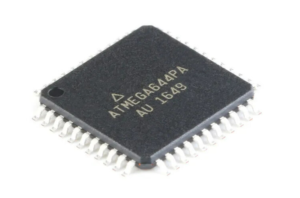
The ability to recover and restore firmware from a protected ATmega644PA chip delivers substantial strategic value to clients. By reconstructing a functional binary or heximal file from a secured microcontroller, organizations can resume manufacturing, perform system maintenance, and migrate legacy applications to updated hardware platforms. Access to a verified memory dump also enables firmware analysis, debugging, and long-term product support. Instead of redesigning an embedded system from the ground up, clients can rebuild their development environment using recovered program files and restored data archives. Ultimately, Extract MCU ATmega644PA Code services transform an inaccessible microprocessor into a usable technical asset, protecting intellectual property investments and extending the lifecycle of critical embedded products in competitive industries.