“Extract IC Code” is a specialized technology in the field of reverse engineering, focused on retrieving firmware, source code, or binary data from a secured or protected microcontroller (MCU) or microprocessor. This complex process involves various technical methods to access the internal memory of chips—often encrypted, locked, or hidden—to recover the original program or binary file stored inside.
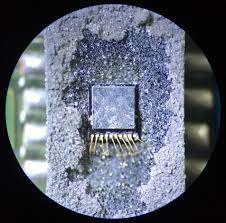
Extract IC code has already become a widely used technology in the electronic product reverse engineering industry. And all of the microcontroller IC manufacturers have already been aware of the security.
As one of the most useful IC code extraction methods, ultra-violet radiation chip firmware extraction is very high efficiency and effective. As a result of that, once microcontroller IC manufacturer realize that their developed IC code can be extracted by the ultra-violet radiation, they will take effective actions against IC code extraction. Some of the microcontroller ICs encrypt by the memorizer base upon EEPROM, such as 87C51 from PHILIPS microcontroller ICs, which has 64 bits encryption list to strength the protection against security fuse.
To successfully extract IC code, one may first decapsulate the chip package to physically access its die. Then, using microprobing or laser techniques, data can be directly read from the memory cells. In other scenarios, a dump of the EEPROM or flash memory is performed using hacking tools or custom-built interfaces. This binary dump, usually in hexadecimal format, is then analyzed and decoded to recover the original program logic or firmware structure.
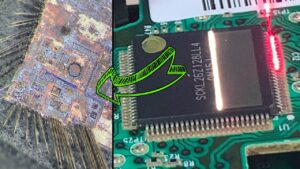
This form of reverse engineering allows experts to duplicate or replicate the behavior of secured chips, restore lost firmware, or even debug and patch outdated systems. Techniques such as code decryption, data recovery, and archive analysis are key in making sense of the raw binary files obtained from the MCU or microprocessor.
Despite its technical complexity, extracting IC code is increasingly used in industries where legacy systems must be supported without official documentation, or in security research where vulnerabilities in encrypted firmware need to be identified. While often controversial, these methods provide critical insights and allow for the restoration, recovery, or forensic analysis of locked or protected microcontroller memory.
In the process of chip binary extraction, even if security fuse be reset, the corresponding bit-stream XNOR in the program flash memorizer list can be extracted. In the PIC16C61 and PIC16C71 from microchip, when the security fuse is working, the content in the memorizer can be encrypted too before crack MCU memory.
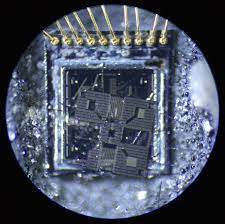
And the encryption method is carry out XNOR operation on the upside case and downside case. Even if the encryption method is very effective, engineer can still use toothpick attacks to wipe out part of the memorizer for extract ic code, and the recover the content and code in the list from IC memorizer. As for the old PIC microcontrollers, code extractor needn’t locate and reset the security fuse, because encrypted content and code can be code by proper programmer.