
The need to extract IC ATtiny261 code is growing as industries seek to maintain, repair, or replicate embedded systems built around this compact yet capable microcontroller. The ATtiny261 is part of Atmel’s well-known AVR family, offering an efficient 8-bit MCU architecture with 2 KB of flash, internal EEPROM, a flexible timer system, built-in comparator, high-performance PWM channels, and extremely low-power operating modes. Because of its balance of size, speed, and stability, the ATtiny261 is widely deployed in lighting controllers, remote sensor modules, motor control devices, consumer electronics, automotive auxiliary modules, and various smart actuators.
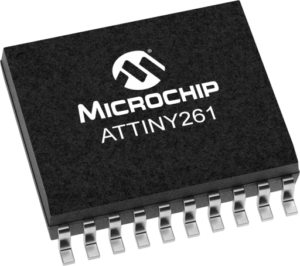
When businesses lose access to the original firmware, source code, or compiled binary program, the chip itself often becomes the only remaining archive of critical system logic. In such cases, it becomes necessary to extract, recover, or open the embedded program stored inside the ATtiny261. However, this MCU commonly employs secured, protected, encrypted, or locked fuse settings intended to shield intellectual property and prevent unauthorized duplication. These safeguards make reading the internal flash, EEPROM, and memory structures far more complex than a standard device dump.
Extract IC ATtiny261 Code from flash memory after cracking mcu attiny261 protective system and breaking the tamper resistance system over microcontroller attiny261 flash and eeprom encrypted memory;
- High Performance, Low Power AVR® 8-Bit Microcontroller
- Advanced RISC Architecture
– 123 Powerful Instructions – Most Single Clock Cycle Execution
– 32 x 8 General Purpose Working Registers
– Fully Static Operation
Non-volatile Program and Data Memories
– 2/4/8K Byte of In-System Programmable Program Memory Flash
(ATtiny261/461/861)
Endurance: 10,000 Write/Erase Cycles
– 128/256/512 Bytes In-System Programmable EEPROM (ATtiny261/461/861)
Endurance: 100,000 Write/Erase Cycles
– 128/256/512 Bytes Internal SRAM (ATtiny261/461/861)
– Programming Lock for Self-Programming Flash Program and EEPROM Data Security
Peripheral Features
– 8/16-bit Timer/Counter with Prescaler and Two PWM Channels
– 8/10-bit High Speed Timer/Counter with Separate Prescaler
3 High Frequency PWM Outputs with Separate Output Compare Registers
Programmable Dead Time Generator
– Universal Serial Interface with Start Condition Detector
– 10-bit ADC
11 Single Ended Channels
16 Differential ADC Channel Pairs
15 Differential ADC Channel Pairs with Programmable Gain (1x, 8x, 20x, 32x)
– Programmable Watchdog Timer with Separate On-chip Oscillator
– On-chip Analog Comparator
Special Microcontroller Features
– debugWIRE On-chip Debug System
– In-System Programmable via SPI Port
– External and Internal Interrupt Sources
– Low Power Idle, ADC Noise Reduction, and Power-down Modes
– Enhanced Power-on Reset Circuit
– Programmable Brown-out Detection Circuit
– Internal Calibrated Oscillator
I/O and Packages
– 16 Programmable I/O Lines
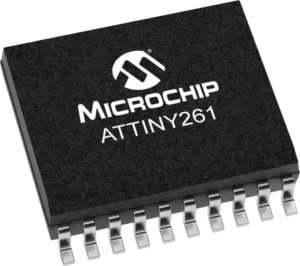
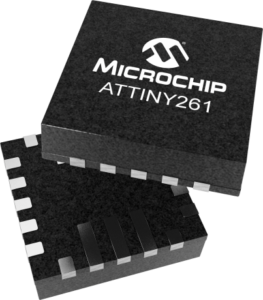
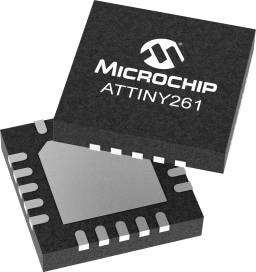
– 20-pin PDIP, 20-pin SOIC and 32-pad MLF
Operating Voltage:
– 1.8 – 5.5V for ATtiny261V/461V/861V
– 2.7 – 5.5V for ATtiny261/461/861
Speed Grade:
– ATtiny261V/461V/861V: 0 – 4 MHz @ 1.8 – 5.5V, 0 – 10 MHz @ 2.7 – 5.5V
– Active Mode: 1 MHz, 1.8V: 380ìA
– Power-down Mode: 0.1ìA at 1.8V
Typical values contained in this data sheet are based on simulations and characterization of other AVR microcontrollers manufactured on the same process technology. Min and Max values will be available after the device is characterized.
The ATtiny261/461/861 is a low-power CMOS 8-bit microcontroller based on the AVR enhanced RISC architecture. By executing powerful instructions in a single clock cycle, the ATtiny261/461/861 achieves throughputs approaching 1 MIPS per MHz allowing the system designer to optimize power consumption versus processing speed.
Breaking through these layers is not a simple “hack,” but rather a highly specialized reverse-engineering process. It demands an expert understanding of the microcontroller’s architecture, timing behavior, and access control mechanisms. Although we do not disclose confidential details of how the extraction is performed, our approach ensures that the microprocessor remains undamaged and that the recovered file, data, or heximal program archive remains intact. Precision methods allow us to restore and reconstruct a complete and reliable MCU dump for further use.
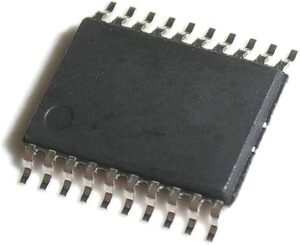
The reasons for performing this type of extraction are legitimate and important. Many companies rely on legacy equipment whose original developers are no longer available, or they must replicate discontinued modules to keep production lines running. Others need to analyze the existing codebase for upgrades or interoperability. Extracting the program enables clients to maintain their systems without redesigning hardware or rewriting software from scratch. It ensures compatibility, reduces downtime, and preserves years of development investment.
By offering professional readout and ATtiny261 code extraction services, we help businesses turn a locked microcontroller into accessible engineering knowledge. The recovered program becomes a valuable asset for diagnostics, replication, customization, or long-term product support—empowering clients to secure their operational continuity and extend the life of their embedded solutions.