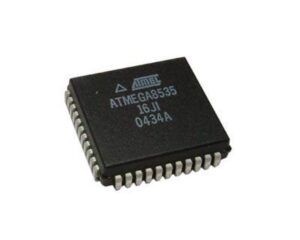
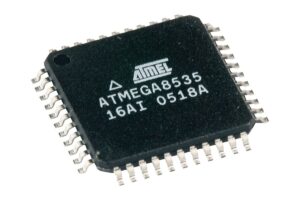
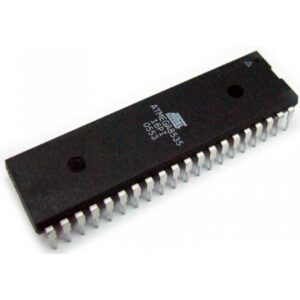
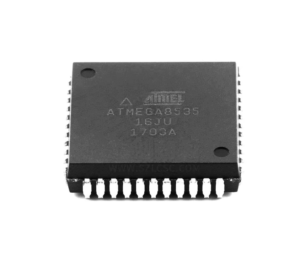
The ability to extract IC ATmega8535 code has become a specialized demand in the field of hardware security analysis and embedded system maintenance. The ATmega8535, a high-performance microcontroller (MCU) from Atmel’s AVR family, is widely deployed in industrial automation, instrumentation, robotics, and consumer electronics. With its 8-bit RISC core, 8KB of flash, 512B of EEPROM, and 32 general-purpose registers, this chip is considered both versatile and reliable. Its popularity, however, also makes it a frequent target for reverse engineering when engineers need to recover legacy firmware or duplicate systems where documentation or source code has been lost.
A Microchip ATmega8535 mikrovezérlő kódjának kinyerésének folyamata jól szemlélteti a biztonsági tervezés és a mérnöki szükségszerűség metszéspontját. Ennek a titkosított ATMEL MCU-nak a védett architektúrája szándékosan úgy van kialakítva, hogy ellenálljon a duplikációnak, de a dekódolást, visszafejtést és támadási stratégiákat magában foglaló szakértői technikákkal értékes firmware-t lehet helyreállítani vagy visszaállítani.
When code protection features are enabled, the ATmega8535 becomes a secured and locked device. The built-in security fuse bits are specifically designed to prevent direct access to the internal program memory and data archive. This creates significant obstacles for anyone attempting to copy, dump, or restore the original binary file. For organizations seeking to replicate existing hardware or recover heximal dumps from aging controllers, conventional programming tools are not sufficient once the chip has been protected.
Extract IC ATmega8535 Code needs to hack mcu atmega8535 flash memory and break atmel avr microcontroller atmega8535 flash and eeprom memory security fuse bit;
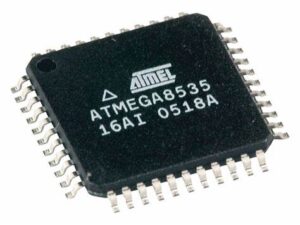
The AVR core combines a rich instruction set with 32 general purpose working registers. All 32 registers are directly connected to the Arithmetic Logic Unit (ALU), allowing two independent registers to be accessed in one single instruction executed in one clock cycle.
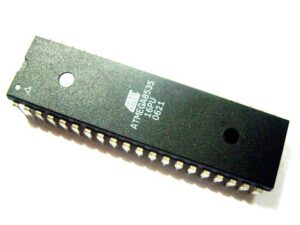
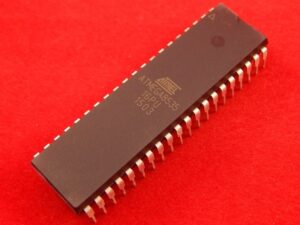
The resulting architecture is more code efficient while achieving throughputs up to ten times faster than conventional CISC microcontrollers. The ATmega8535 provides the following features: 8K bytes of In-System Programmable Flash with Read-While-Write capabilities, 512 bytes EEPROM, 512 bytes SRAM, 32 general purpose I/O lines, 32 general purpose working registers, three flexible Timer/Counters with compare modes, internal and external interrupts, a serial programmable USART, a byte oriented Two-wire Serial Interface, an 8-channel, 10-bit ADC with optional differential input stage with programmable gain in TQFP package, a programmable Watchdog Timer with Internal Oscillator, an SPI serial port, and six software selectable power saving modes.
Proces extrakcie kódu mikrokontroléra Microchip ATmega8535 ilustruje prienik bezpečnostného návrhu a inžinierskej nevyhnutnosti. Chránená architektúra tohto šifrovaného mikrokontroléra ATMEL je zámerne vytvorená tak, aby odolávala duplikácii, ale s odbornými technikami zahŕňajúcimi dekódovanie, dešifrovanie a stratégie útoku je možné obnoviť alebo obnoviť cenný firmvér.
To bypass these barriers, specialists may apply advanced hardware-level and algorithmic methods. Typical approaches include:
-
Decapsulation of the chip package, which exposes the silicon die for further examination under microscopy. This allows physical probing of bus lines or the application of laser fault injections to disrupt security mechanisms.
-
Fault injection attacks, where voltage or clock manipulation is used to momentarily disable the protection logic, creating a window to dump partial memory data.
-
Side-channel analysis, focusing on power consumption patterns or electromagnetic leakage, which can be correlated to internal cryptographic operations to decode secrets.
-
Bootloader exploitation or legacy debug mode tricks, provided the configuration was not fully locked at deployment.
Each of these techniques requires highly specialized knowledge, advanced laboratory equipment, and careful precision. Unlike simple attempts to hack or crack older MCUs without protection, extracting from an encrypted or secured ATmega8535 involves iterative experimentation, error analysis, and constant adaptation to the chip’s robust defense mechanisms.
The Idle mode stops the CPU while allowing the SRAM, Timer/Counters, SPI port, and interrupt system to continue functioning. The Power-down mode saves the register contents but freezes the Oscillator, disabling all other chip functions until the next interrupt or Hardware Reset.
In Power-save mode, the asynchronous timer continues to run, allowing the user to maintain a timer base while the rest of the device is sleeping. The ADC Noise Reduction mode stops the CPU and all I/O modules except asynchronous timer and ADC, to minimize switching noise during ADC conversions after Extract mcu at90s1200 code.
In Standby mode, the crystal/resonator Oscillator is running while the rest of the device is sleeping. This allows very fast start-up combined with low-power consumption. In Extended Standby mode, both the main Oscillator and the asynchro- nous timer continue to run.
Proces extrakce kódu mikrokontroléru Microchip ATmega8535 ilustruje průnik bezpečnostního návrhu a inženýrské nutnosti. Chráněná architektura tohoto šifrovaného mikrokontroléru ATMEL je záměrně navržena tak, aby odolávala duplikaci, ale s odbornými technikami zahrnujícími dekódování, dešifrování a útočné strategie je možné obnovit cenný firmware.
The device is manufactured using Atmel’s high density nonvolatile memory technology. The On-chip ISP Flash allows the program memory to be reprogrammed In-System through an SPI serial interface, by a conventional nonvolatile memory programmer, or by an On-chip Boot program running on the AVR core if Extract at90s2313 IC.
The boot program can use any interface to download the application program in the Application Flash memory. Software in the Boot Flash section will continue to run while the Application Flash section is updated, providing true Read-While-Write operation.
By combining an 8-bit RISC CPU with In-System Self-Programmable Flash on a monolithic chip, the Atmel ATmega8535 is a powerful microcontroller that provides a highly flexible and cost effective solution to many embedded control applications.
The ATmega8535 AVR is supported with a full suite of program and system development tools including: C compilers, macro assemblers, program debugger/simulators, In-Circuit Emulators, and evaluation kits.
The industrial applications of the ATmega8535 amplify the importance of code recovery. In factory automation, for instance, custom firmware often drives critical control logic. In the medical and instrumentation fields, devices built around this MCU may no longer have vendor support, leaving firmware archives as the only way to ensure continuity of operation. By successfully performing a clone or replicate operation, engineers can extend the life cycle of vital systems, even when the original source code is permanently lost.
Postupak izdvajanja koda mikrokontrolera Microchip ATmega8535 ilustrira presjek sigurnosnog dizajna i inženjerske nužnosti. Zaštićena arhitektura ovog šifriranog ATMEL MCU-a namjerno je izgrađena kako bi se oduprla dupliciranju, ali stručnim tehnikama koje uključuju strategije dekodiranja, dešifriranja i napada moguće je oporaviti ili vratiti vrijedan firmware.
However, the difficulty lies not only in the technical attack strategy, but also in ensuring that the recovered file is intact, functional, and matches the original design intent. A corrupted or partial dump may render the microprocessor clone unreliable. This is why professionals in reverse engineering emphasize validation, checksum analysis, and careful restoration of both EEPROM calibration data and flash program space.
In conclusion, the process to extract IC ATmega8535 code illustrates the intersection of security design and engineering necessity. The protected architecture of this MCU is deliberately built to resist duplication, but with expert techniques involving decode, decrypt, and attack strategies, it is possible to recover or restore valuable firmware. Such work is complex, delicate, and essential for keeping critical embedded systems operational long after original development resources have disappeared.