Extract Chip by Laser Cutting & Focus Ion Beam

Modern hardware often relies on secured, locked, and encrypted microcontrollers (MCUs) and microprocessors to protect critical firmware, source code, or EEPROM data. However, advanced techniques like Extract Chip by Laser Cutting & Focus Ion Beam (FIB) are increasingly used by researchers and attackers to decapsulate, attack, and recover otherwise protected content.
आधुनिक हार्डवेयर अक्सर महत्वपूर्ण फ़र्मवेयर, सोर्स कोड या EEPROM डेटा की सुरक्षा के लिए सुरक्षित, लॉक और एन्क्रिप्टेड माइक्रोकंट्रोलर (MCU) और माइक्रोप्रोसेसर पर निर्भर करता है। हालाँकि, लेजर कटिंग और फोकस आयन बीम (FIB) द्वारा एक्सट्रैक्ट चिप जैसी उन्नत तकनीकों का उपयोग शोधकर्ताओं और हमलावरों द्वारा अन्यथा संरक्षित सामग्री को डीकैप्सुलेट करने, हमला करने और पुनर्प्राप्त करने के लिए किया जाता है। लेजर कटिंग का उपयोग करके चिप को भौतिक रूप से उजागर करके, और फिर एक केंद्रित आयन बीम के साथ आंतरिक कनेक्शन को सटीक रूप से लक्षित करके, विशेषज्ञ सुरक्षा फ़्यूज़ को क्रैक कर सकते हैं या रीडआउट पथ को फिर से रूट कर सकते हैं। यह डिवाइस के भीतर संग्रहीत फ्लैश मेमोरी, बाइनरी फ़ाइलों और प्रोग्राम डेटा को निकालने या डंप करने की अनुमति देता है। एक बार निकाले जाने के बाद, इस डेटा को डिकोड, डिक्रिप्ट और यहां तक ​​कि प्रतिकृति या क्लोन भी किया जा सकता है, जिससे मालिकाना डिज़ाइनों की नकल की जा सकती है।

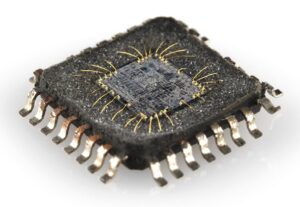
By physically exposing the chip using laser cutting, and then precisely targeting internal connections with a focused ion beam, experts can crack security fuses or reroute readout paths. This allows the extraction or dumping of flash memory, binary files, and program data stored within the device. Once extracted, this data can be decoded, decrypted, and even replicated or cloned, allowing for duplication of proprietary designs.

These invasive methods not only break through locked protection mechanisms but also make it possible to hack and copy valuable archives from devices once considered secure. The decoded firmware can then be studied, reverse-engineered, or reused. While these processes are technically demanding, they raise critical concerns about hardware security and the vulnerability of supposedly secure embedded chips.

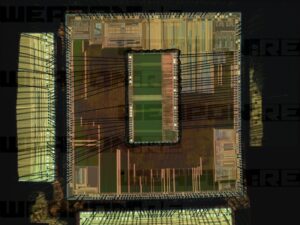
When extract chip, we will normally find the deactivation layer cover on the aluminum wire connection internally, so the deactivation layer must be removed. The most convenient method is using laser cutting to remove the deactivation layer which is a critical step for MCU Cracking.
최신 하드웨어는 중요한 펌웨어, 소스 코드 또는 EEPROM 데이터를 보호하기 위해 보안, 잠금 및 암호화된 마이크로컨트롤러(MCU)와 마이크로프로세서에 의존하는 경우가 많습니다. 그러나 레이저 절단 및 집속 이온 빔(FIB)을 이용한 칩 추출과 같은 고급 기술은 연구원과 공격자들이 보호된 콘텐츠를 캡슐화 해제, 공격 및 복구하는 데 점점 더 많이 사용되고 있습니다. 전문가들은 레이저 절단을 사용하여 칩을 물리적으로 노출시킨 다음 집속 이온 빔으로 내부 연결을 정밀하게 조준함으로써 보안 퓨즈를 해독하거나 판독 경로를 변경할 수 있습니다. 이를 통해 장치 내에 저장된 플래시 메모리, 바이너리 파일 및 프로그램 데이터를 추출하거나 덤핑할 수 있습니다. 추출된 데이터는 디코딩, 암호 해독, 심지어 복제 또는 복제될 수 있으며, 이를 통해 독점 설계를 복제할 수 있습니다.

Ultra-sonic laser cutting can be used to remove the POLYIMIDE or other organic layer which are generally will existence on the top of deactivation layer. Ultra-sonic laser cutting can also be use to strip off the deactivation layer, for example, green laser being used to cut the metal wire, and red laser being use to cut top layer metal and make access to the second metal layer.

Focus Ion Beam

As for the chip with 0.5micron or below need more effective and advanced facility to establish the internal wire connection for MCU ATMEGA162L Code Reading. That is the focus ion beam station which can not only build the test point, it can also being used to image and recover when extract chip. In the failure analysis, focus ion beam can be used to cross section and failure analysis. It has very good space resolution and preciseness which is very important for chip extract, its preciseness and space resolution is good enough to make detecting point on the crystal transistor on the chip with sub-micron technology in the process of Extract MCU ATMEGA8P Code.

Focus Ion beam work station for chip extract include a vacuum chamber, a electronic gun through which the gallium ion inject out from the liquid cathode and make it to beam which has 5 to 10 nano meter for extract chip. Through increase the electricity level of ion beam the chip material can be removed and cut off.
Le matériel moderne repose souvent sur des microcontrôleurs (MCU) et des microprocesseurs sécurisés, verrouillés et chiffrés pour protéger les micrologiciels critiques, le code source ou les données EEPROM. Cependant, des techniques avancées comme l'extraction de puces par découpe laser et focalisation du faisceau d'ions (FIB) sont de plus en plus utilisées par les chercheurs et les attaquants pour décapsuler, attaquer et récupérer des contenus jusque-là protégés. En exposant physiquement la puce par découpe laser, puis en ciblant précisément les connexions internes avec un faisceau d'ions focalisé, les experts peuvent percer les fusibles de sécurité ou rediriger les chemins de lecture. Cela permet d'extraire ou de vider la mémoire flash, les fichiers binaires et les données de programme stockés dans l'appareil. Une fois extraites, ces données peuvent être décodées, déchiffrées, voire répliquées ou clonées, permettant ainsi la duplication de conceptions propriétaires.
Le matériel moderne repose souvent sur des microcontrôleurs (MCU) et des microprocesseurs sécurisés, verrouillés et chiffrés pour protéger les micrologiciels critiques, le code source ou les données EEPROM. Cependant, des techniques avancées comme l’extraction de puces par découpe laser et focalisation du faisceau d’ions (FIB) sont de plus en plus utilisées par les chercheurs et les attaquants pour décapsuler, attaquer et récupérer des contenus jusque-là protégés. En exposant physiquement la puce par découpe laser, puis en ciblant précisément les connexions internes avec un faisceau d’ions focalisé, les experts peuvent percer les fusibles de sécurité ou rediriger les chemins de lecture. Cela permet d’extraire ou de vider la mémoire flash, les fichiers binaires et les données de programme stockés dans l’appareil. Une fois extraites, ces données peuvent être décodées, déchiffrées, voire répliquées ou clonées, permettant ainsi la duplication de conceptions propriétaires.