
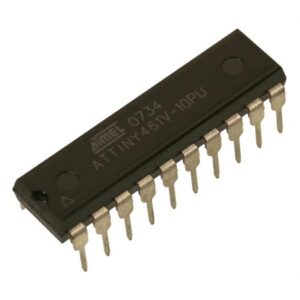
The demand to extract chip ATtiny461V code has increased significantly across industries that rely on compact, low-power embedded control systems. The ATtiny461V is a robust 8-bit microcontroller, equipped with 4 KB of flash memory, internal EEPROM, flexible programmable timers, high-efficiency PWM channels, a versatile analog comparator, and a rich set of I/O interfaces. Its ultra-low-voltage operating capability and high processing efficiency make it ideal for applications such as industrial sensor modules, motor-control drivers, lighting controllers, consumer electronics, environmental monitoring devices, and battery-powered automation products.
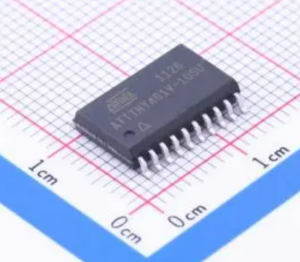
In many scenarios, the only complete and functional firmware or source code available resides inside the ATtiny461V itself. When original engineering documentation is lost, discontinued, or inaccessible, organizations often need to recover, extract, or open the microcontroller’s embedded binary, heximal, or configuration data. This requirement becomes urgent in maintenance, product refurbishment, control board replication, or when enhancing an existing system without rewriting the entire program from the ground up.
Extract Chip ATtiny461V Code from its locked flash memory after crack microcontroller attiny461 security fuse bit and extract mcu attiny461 heximal from its flash and eeprom memory;
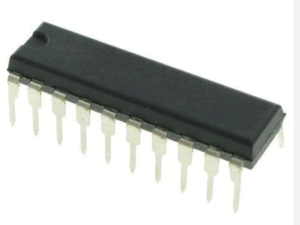
Port 2 is an 8-bit bi-directional I/O port with internal pull-ups. The Port 2 output buffers can sink/source four TTL inputs. When 1s are written to Port 2 pins, they are pulled high by the internal pull-ups and can be used as inputs. As inputs, Port 2 pins that are externally being pulled low will source current (IIL) because of the internal pull-ups.
Port 2 emits the high-order address byte during fetches from external program memory and during accesses to external data memory that use 16-bit addresses (MOVX @ DPTR). In this application, Port 2 uses strong internal pull-ups when emitting 1s. During accesses to external data memory that use 8-bit addresses (MOVX @ RI), Port 2 emits the contents of the P2 Special Function Register.
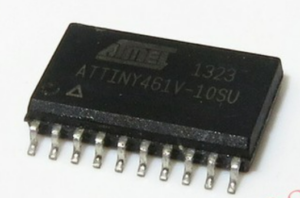
Port 2 also receives the high-order address bits and some control signals during Flash programming and verification.
Port 3 is an 8-bit bi-directional I/O port with internal pull-ups. The Port 3 output buffers can sink/source four TTL inputs. When 1s are written to Port 3 pins, they are pulled high by the internal pull-ups and can be used as inputs. As inputs, Port 3 pins that are externally being pulled low will source current (IIL) because of the pull-ups.
Port 3 receives some control signals for Flash programming and verification. Reset input. A high on this pin for two machine cycles while the oscillator is running resets the device. This pin drives High for 98 oscillator periods after the Watchdog times out.
The DISRTO bit in SFR AUXR (address 8EH) can be used to disable this feature. In the default state of bit DISRTO, the RESET HIGH out feature is enabled.
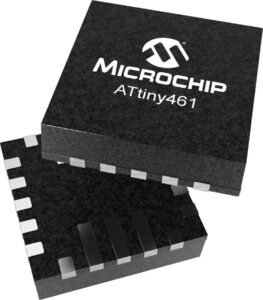
Address Latch Enable (ALE) is an output pulse for latching the low byte of the address during accesses to external memory. This pin is also the program pulse input (PROG) during Flash programming.
However, retrieving a meaningful dump or archive from a secured, protected, encrypted, or locked microcontroller involves substantial technical complexity. The ATtiny461V uses multiple readout-protection fuses and structured memory-access restrictions to prevent unwanted duplication. These protection schemes make direct access to the internal memory, flash, or EEPROM impossible with conventional tools. Overcoming these barriers requires specialized reverse engineering capabilities, advanced chip-level understanding, and precise handling of the microprocessor architecture.
Although the extraction procedures are often described informally as a hack, the real process is a controlled, highly technical operation. Modern chip-analysis techniques enable us to restore program files, retrieve deeply embedded logic blocks, and reconstruct the complete operational archive without compromising device integrity. The goal is always to generate a clean, accurate, and fully usable firmware structure that clients can leverage for production continuity or product redevelopment.
In normal operation, ALE is emitted at a constant rate of 1/6 the oscillator frequency and may be used for external timing or clocking purposes. Note, however, that one ALE pulse is skipped during each access to external data memory.
If desired, ALE operation can be disabled by setting bit 0 of SFR location 8EH. With the bit set, ALE is active only during a MOVX or MOVC instruction. Otherwise, the pin is weakly pulled high. Setting the ALE-disable bit has no effect if the microcontroller is in external execution mode.
Program Store Enable (PSEN) is the read strobe to external program memory. When the AT89LS52 is executing code from external program memory, PSEN is activated twice each machine cycle, except that two PSEN activations are skipped during each access to external data memory.
There are several compelling reasons why companies pursue the extraction of ATtiny461V code. First, it preserves legacy intellectual assets that are otherwise irreplaceable. Second, it enables board reproduction, system upgrading, and failure analysis without needing access to the original development environment. Third, it supports cost-efficient modernization of long-life industrial systems where replacing the entire platform is impractical.
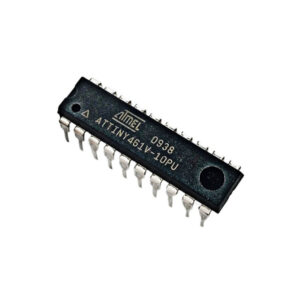
Ultimately, the ability to extract ATtiny461V code empowers clients to maintain, duplicate, improve, or re-engineer their products with confidence. Through precise, reliable recovery of embedded program logic, we help extend product lifecycles, reduce development overhead, and protect valuable technical investment across diverse application domains.