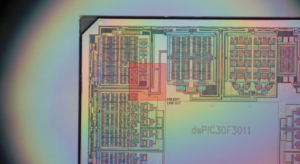
The dsPIC30F3011 is a 16-bit digital signal controller from Microchip that combines conventional microcontroller functions with DSP-oriented processing capabilities. This architecture makes the MCU particularly useful where fast mathematical operations, deterministic control, and peripheral coordination are required. Typical applications can include motor-control equipment, industrial drives, power-conversion systems, intelligent power supplies, instrumentation, automation controllers, and other embedded products that depend on real-time processing.
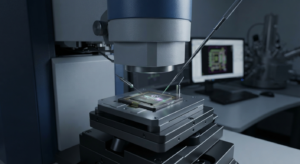
The chip can execute sophisticated control algorithms while communicating with sensors, converters, displays, and external circuits. For manufacturers, the embedded software running inside this microchip may therefore be as important as the PCB itself. When the original development environment or software archive is no longer available, recovering that embedded program can become an important part of product preservation and engineering maintenance.
The Baud Rate Generator begins counting and on each rollover, the state of the SCL pin changes (high-to-low/ low-to-high) and data is shifted into the SSPSR. After the falling edge of the eighth clock, the receive enable flag is automatically cleared, the contents of the SSPSR are loaded into the SSPBUF, the BF flag bit is set, the SSPIF flag bit is set and the Baud Rate Generator is suspended from counting, holding SCL low. The MSSP is now in Idle state awaiting the next command. When the buffer is read by the CPU, the BF flag bit is automatically cleared. The user can then send an Acknowledge bit at the end of reception by setting the Acknowledge Sequence Enable bit, ACKEN (SSPCON2<4>).
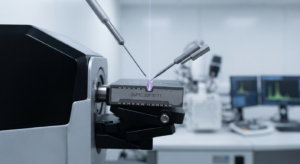
The requirement to copy embedded firmware of secured MCU dsPIC30F3011 normally concerns an existing device for which authorized engineers need to preserve or investigate the original software. If the chip is secured, protected, encrypted, or locked, standard programming equipment may not provide ordinary read access to its internal memory. Depending on the project, specialists may attempt to hack, extract, recover, open, or restore relevant firmware, binary, heximal, program, or data resources. A controlled memory dump may become a valuable file or archive for subsequent engineering analysis.
The recovery target can include flash, eeprom, configuration information, calibration parameters, and other embedded resources associated with the microcontroller. It is important to understand that a recovered binary is not automatically equivalent to the original source code. Additional reverse engineering may be necessary to interpret program structures, identify functional sections, and understand how the firmware communicates with the surrounding electronics. The purpose of this work is to preserve usable technical information from the original MCU rather than simply produce an unexplained collection of bytes.
In receive operation, the BF bit is set when an address or data byte is loaded into SSPBUF from SSPSR. It is cleared when the SSPBUF register is read. In receive operation, the SSPOV bit is set when 8 bits are received into the SSPSR and the BF flag bit is already set from a previous reception. If the user writes the SSPBUF when a receive is already in progress (i.e., SSPSR is still shifting in a data byte), the WCOL bit is set and the contents of the buffer are unchanged (the write doesn’t occur). An Acknowledge sequence is enabled by setting the Acknowledge Sequence Enable bit, ACKEN (SSPCON2<4>). When this bit is set, the SCL pin is pulled low and the contents of the Acknowledge data bit are presented on the SDA pin.
If the user wishes to generate an Acknowledge, then the ACKDT bit should be cleared. If not, the user should set the ACKDT bit before starting an Acknowledge sequence. The Baud Rate Generator then counts for one rollover period (TBRG) and the SCL pin is deasserted (pulled high). When the SCL pin is sampled high (clock arbitration), the Baud Rate Generator counts for TBRG. The SCL pin is then pulled low. Following this, the ACKEN bit is automatically cleared, the Baud Rate Generator is turned off and the MSSP module then goes into Idle mode.
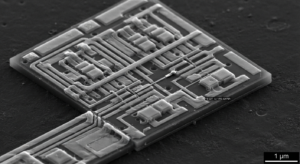
A dsPIC30F3011 protected-memory project can involve considerably more complexity than ordinary firmware programming. The locked state may restrict access to program flash, while protection mechanisms can complicate attempts to obtain a complete and reliable dump. Engineers performing reverse engineering must evaluate the physical condition of the microchip, the available hardware documentation, device configuration, and the relationship between firmware and external circuitry.
During an extract, recover, or restore project, maintaining the integrity of every relevant file, binary, heximal image, eeprom value, and memory region is important. Damaged hardware, unstable electrical conditions, undocumented board revisions, corrupted information, and missing calibration data can all influence the final result. A successful recovery therefore involves more than attempting to open a protected MCU; it requires validation of the recovered archive and careful interpretation of the program. Where technically feasible, this approach can provide engineers with a dependable reference for troubleshooting, preservation, redesign, or migration without requiring disclosure of detailed protection-defeating procedures.
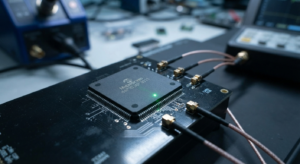
For clients, recovering the embedded firmware of a dsPIC30F3011 can protect years of previous engineering investment. A verified firmware archive can help maintain discontinued equipment, produce replacement control boards, investigate field failures, and support refurbishment programs. Recovered binary or heximal information can also provide a starting point for migrating an established application to a newer microcontroller or microprocessor when the original chip is approaching the end of its practical service life.
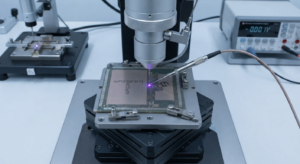
In industrial environments, preserving proven control software can be considerably more efficient than recreating an entire application from the beginning. The resulting technical archive may also help organizations document legacy products, compare hardware revisions, and retain important operational knowledge. Ultimately, professional recovery of a secured dsPIC30F3011 can turn an inaccessible embedded program into a usable engineering resource, helping clients extend product lifecycles, reduce redevelopment costs, and maintain continuity across generations of electronic equipment.