
Readout MCU ATmega1280V Program refers to the professional practice of obtaining a usable binary or heximal representation of the embedded program stored inside a secured ATmega1280V microcontroller. As a low-voltage variant of the ATmega1280 family, the ATmega1280V is designed for energy-efficient systems while still offering substantial flash capacity, on-chip EEPROM, and extensive memory resources. These characteristics make it a preferred MCU for complex, long-life electronic products.
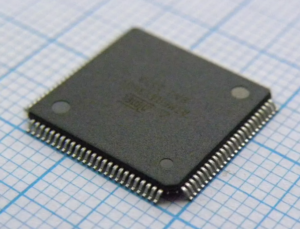
The ATmega1280V integrates a powerful 8-bit AVR microprocessor core with up to 128 KB of flash program space, multiple serial interfaces, advanced timers, and rich I/O capability. In many applications, critical firmware logic, configuration tables, and runtime parameters are stored across flash and EEPROM. When original source code or documentation is unavailable, engineers may need to extract a complete dump of the program memory and convert it into a structured file or secure archive for further analysis.
1. Non-Read-While-Write area of flash not functional
Part does not work under 2.4 volts
Incorrect ADC reading in differential mode
Internal ADC reference has too low value
IN/OUT instructions may be executed twice when Stack is in external RAM
EEPROM read from application code does not work in Lock Bit Mode 3
Non-Read-While-Write area of flash not functional
The Non-Read-While-Write area of the flash is not working as expected. The problem is related to the speed of the part when reading the flash of this area.
Problem Fix/Workaround
– Only use the first 248K of the flash.
– If boot functionality is needed, run the code in the Non-Read-While-Write area at maximum
1/4th of the maximum frequency of the device at any given voltage. This is done by writing the CLKPR register before entering the boot section of the code
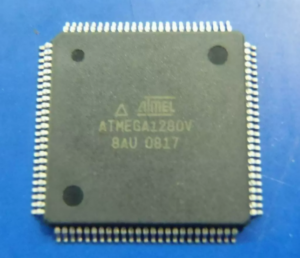
- Part does not work under 2.4 volts
The part does not execute code correctly below 2.4 volts
This MCU is commonly deployed in industrial controllers, smart power equipment, data acquisition units, test and measurement instruments, and customized automation platforms. Because these products often operate in sensitive environments, the chip is usually configured as secured, protected, or fully locked. Some systems even apply additional encrypted layers to prevent unauthorized access to internal data. Under such conditions, a standard programmer cannot open or read the program contents.
The challenge of accessing a locked ATmega1280V lies in balancing data recovery with device safety. Protection fuses and security mechanisms are specifically designed to resist direct readout attempts. Improper handling may permanently erase valuable flash or EEPROM regions. As a result, advanced reverse engineering techniques are required to carefully recover and restore the internal program without damaging the MCU. While the process is sometimes casually described as a hack, legitimate readout services focus on controlled, non-destructive access rather than experimentation.
The motivation for performing a readout is driven by real business needs. Manufacturers may require program access to maintain legacy products, migrate designs to new hardware, or resolve field failures. System owners often need to restore archived data after unexpected loss or supplier discontinuation. By recovering the original program and related data, organizations can avoid costly redevelopment and reduce downtime.
Problem Fix/Workaround
Do not use the part at voltages below 2.4 volts.
- Incorrect ADC reading in differential mode
The ADC has high noise in differential mode. It can give up to 7 LSB error.
Problem Fix/Workaround
Use only the 7 MSB of the result when using the ADC in differential mode.
- Internal ADC reference has too low value
The internal ADC reference has a value lower than specified
Problem Fix/Workaround
– Use AVCC or external reference
– The actual value of the reference can be measured by applying a known voltage to the
ADC when using the internal reference. The result when doing later conversions can then be calibrated.
- IN/OUT instructions may be executed twice when Stack is in external RAM
If either an IN or an OUT instruction is executed directly before an interrupt occurs and the stack pointer is located in external ram, the instruction will be executed twice. In some cases this will cause a problem, for example:
– If reading SREG it will appear that the I-flag is cleared.
– If writing to the PIN registers, the port will toggle twice.
– If reading registers with interrupt flags, the flags will appear to be cleared.
Problem Fix/Workaround
There are two application work-arounds, where selecting one of them, will be omitting the issue:
– Replace IN and OUT with LD/LDS/LDD and ST/STS/STD instructions
– Use internal RAM for stack pointer.
- EEPROM read from application code does not work in Lock Bit Mode 3
When the Memory Lock Bits LB2 and LB1 are programmed to mode 3, EEPROM read does not work from the application code.
Problem Fix/Workaround
Do not set Lock Bit Protection Mode 3 when the application code needs to read from EEPROM.
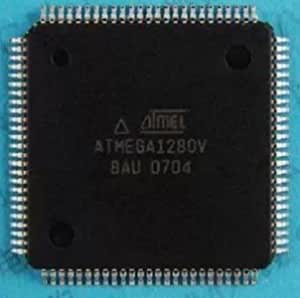
Ultimately, professional readout of an ATmega1280V program provides clients with continuity, technical independence, and long-term value. Access to the recovered firmware and memory archive enables informed decision-making, protects prior investment, and extends the service life of embedded systems that remain critical to daily operations.