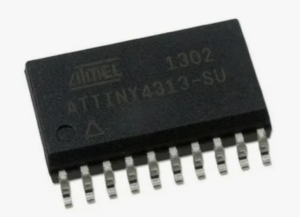
The demand to extract Microcontroller ATtiny4313 code has increased as more companies rely on legacy embedded platforms that must continue operating long after the original development resources are no longer available. The ATtiny4313 is a compact but capable 8-bit MCU featuring 4 KB of flash, 256 bytes of EEPROM, robust timers, UART support, and efficient low-power performance. This microcontroller is widely deployed across consumer electronics, small industrial controllers, access control systems, communication modules, motor control devices, and various programmable smart gadgets. Its reliability makes it a common choice in applications where cost, simplicity, and durability matter.
When the original firmware, source code, or archived heximal program file becomes unavailable, the only remaining source of the essential program data is often the chip itself. In these cases, companies must recover, open, or restore the internal binary dump directly from the microcontroller. However, the ATtiny4313 typically employs secured, protected, encrypted, or locked fuse settings that prevent standard readout. These safeguards are intentionally built into the MCU to protect intellectual property, but they also make reverse engineering and data extraction challenging when performed for legitimate maintenance and product continuity.
Extract Microcontroller ATtiny4313 Code from its flash and eeprom memory after reverse attiny4313 protection over the memory, and recover the secured heximal from attiny4313 chip;
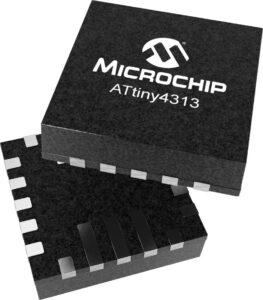
The ATtiny2313A/4313 provides the following features: 2/4K bytes of In-System Programmable Flash, 128/256 bytes EEPROM, 128/256 bytes SRAM, 18 general purpose I/O lines, 32 general purpose working registers, a single-wire Interface for On-chip Debugging.
Two flexible Timer/Counters with compare modes, internal and external interrupts, a serial programmable USART, Universal Serial Interface with Start Condition Detector, a programmable Watchdog Timer with internal Oscillator, and three software selectable power saving modes.
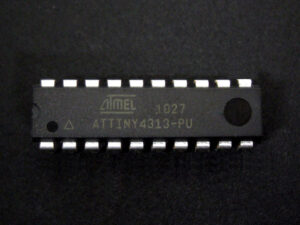
The Idle mode stops the CPU while allowing the SRAM, Timer/Counters, and interrupt system to continue functioning. The Power-down mode saves the register contents but freezes the Oscillator, disabling all other chip functions until the next interrupt or hardware reset.
In Standby mode, the crystal/resonator Oscillator is running while the rest of the device is sleeping. This allows very fast start-up combined with low-power consumption.
The device is manufactured using Atmel’s high density non-volatile memory technology. The On-chip ISP Flash allows the program memory to be reprogrammed In-System through an SPI serial interface, or by a conventional non-volatile memory programmer.
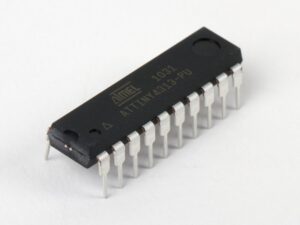
By combining an 8-bit RISC CPU with In-System Self-Programmable Flash on a monolithic chip, the Atmel ATtiny2313A/4313 is a powerful microcontroller that provides a highly flexible and cost effective solution to many embedded control applications.
The ATtiny2313A/4313 AVR is supported with a full suite of program and system development tools including: C Compilers, Macro Assemblers, Program Debugger/Simulators, In-Circuit Emulators, and Evaluation kits.
This documentation contains simple code examples that briefly show how to use various parts of the device. These code examples assume that the part specific header file is included before compilation. Be aware that not all C compiler vendors include bit definitions in the header files and interrupt handling in C is compiler dependent. Please confirm with the C compiler documentation for more details.
For I/O Registers located in the extended I/O map, “IN”, “OUT”, “SBIS”, “SBIC”, “CBI”, and “SBI” instructions must be replaced with instructions that allow access to extended I/O. Typically, this means “LDS” and “STS” combined with “SBRS”, “SBRC”, “SBR”, and “CBR”. Note that not all AVR devices include an extended I/O map.
Typical values contained in this datasheet are based on simulations and characterization of other AVR microcontrollers manufactured on the same process technology. Min and Max values will be available after the device has been characterized.
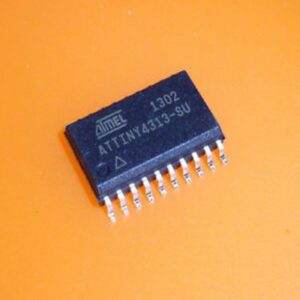
Overcoming these barriers requires a deep understanding of memory structures, flash layout, EEPROM mapping, and the behavior of the microprocessor under different access conditions. While we do not disclose specific techniques, our approach focuses on safe, controlled procedures rather than brute-force hacking. This ensures that the internal file, data, or program archive is preserved without damaging the chip. Using advanced tools and professional reverse-engineering methodologies, we can reliably extract, recover, and reconstruct the firmware from a secured ATtiny4313.
The importance of this process is especially clear for manufacturers who must support aging equipment, replicate discontinued modules, or produce compatible replacement units. Restoring the embedded program from a locked microcontroller eliminates the risk of system downtime and avoids costly redesigns. It allows clients to maintain production schedules, protect their investment, and ensure that essential machinery, instruments, or consumer devices continue operating as intended.
By providing a precise and secure readout service for the ATtiny4313, we help businesses transform inaccessible program memory into actionable engineering knowledge. The recovered code becomes an invaluable resource for ongoing development, duplication, troubleshooting, and product life-cycle management—turning a locked chip into a future-proof solution.